Long Island Sound Chlorophyll-a Dynamics Tutorial
Objective
This tutorial will show the steps to grab daily chlorophyll-a data hosted on an ERDDAP server using the griddap function in the rerrdap package, how to make temporal composites in R and how to make some maps and time-series of chlorophyll-a.
The tutorial demonstrates the following techniques:
- Accessing gridded satellite data from an ERDDAP server using the
rerddappackage. - Subsetting spatial and temporal data using latitude, longitude, and date ranges.
- Converting gridded data to tidy format for analysis using
dplyrandlubridate. - Calculating monthly and annual spatial averages of chlorophyll-a concentrations.
- Creating faceted maps of monthly chlorophyll-a using
ggplot2andviridiscolor scales. - Creating an 8-day time series to analyze seasonal chlorophyll-a patterns.
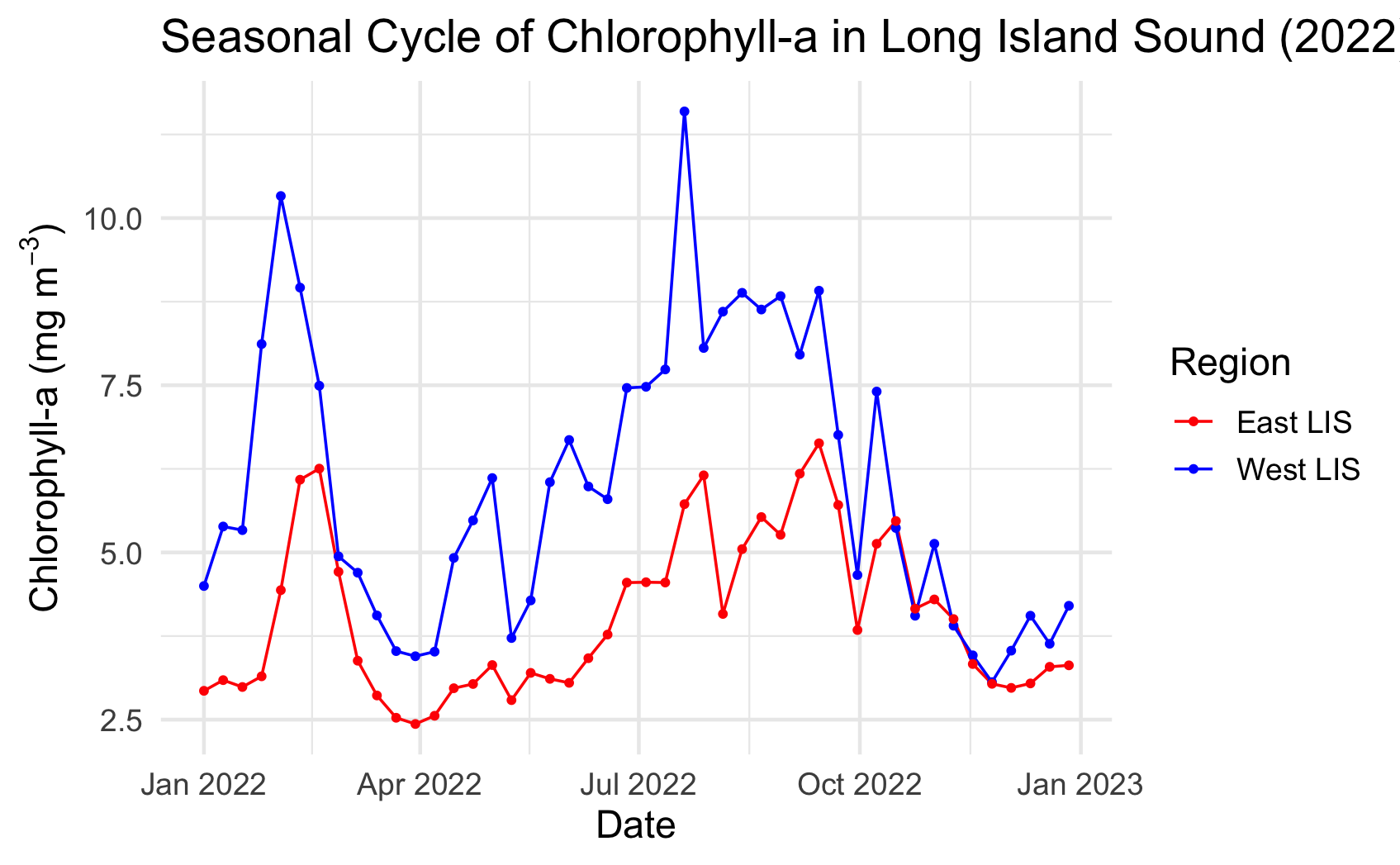
- Comparing chlorophyll-a seasonal cycles between regions (West vs. East Long Island Sound).
Datasets used
Long Island Sound Optimized water quailty datasets from OLCI Products developed by academic collaborators that have partnered with NOAA CoastWatch through a Sea Grant project titled “Actionable satellite water-quality data products in Long Island Sound for improved management and societal benefits”. The dataset includes daily Sentinal-3 OLCI (300 m) water quality indicators:
- Chlorophyll-a (Chla “chlor_a”)
- Absorption coefficient of Chromophoric Dissolved Organic Material at 300 nm (aCDOM(300) “cdom”)
- Dissolved Organic Carbon (DOC “doc”)
- Suspended Particulate Matter (SPM “spm”). Chlor_a, cdom and doc are based on Long Island Sound optimized algorithms. Spm retrieved using the Nechad Algorithm.
This dataset covers the Long Island Sound region between 40.2° N - 41.5° N and 74° W - 71.8° W
In this tutorial we will use the daily Chlorophyll-a dataset. The data will be downloaded from the CoastWatch ERRDAP server: https://coastwatch.noaa.gov/erddap/griddap/noaacwappsS3ABcolorLISDaily.html
For more information on each product refer to:
Install and load packages
pkgTest <- function(x)
{
  if (!require(x,character.only = TRUE))
  {
    install.packages(x,dep=TRUE,repos='http://cran.us.r-project.org')
    if(!require(x,character.only = TRUE)) stop(x, " :Package not found")
  }
}

# Create list of required packages
list.of.packages <- c("rerddap", "tidyverse", "lubridate", "viridis", "ggplot2")

# Create list of installed packages
pkges = installed.packages()[,"Package"]

# Install and load all required pkgs
for (pk in list.of.packages) {
  pkgTest(pk)
}
Select the satellite dataset
We will load the daily Chlorophyll-a dataset from the CoastWatch ERDDAP server. The dataset ID is noaacwappsS3ABcolorLISDaily.
We will use the info function from the rerddap package to first obtain information about the dataset of interest, then we will import the data.
# Set the ERDDAP URL
erddap_url <- "https://coastwatch.noaa.gov/erddap"

# Set the dataset ID
dataset_id <- "noaacwappsS3ABcolorLISDaily"

# Obtain data info using the erddap url and dataset ID
dataInfo <- rerddap::info(dataset_id,url=erddap_url)

# Examine the metadata dataset info
dataInfo
## <ERDDAP info> noaacwappsS3ABcolorLISDaily
## Base URL: https://coastwatch.noaa.gov/erddap
## Dataset Type: griddap
## Dimensions (range):
## time: (2017-01-01T00:00:00Z, 2025-02-28T00:00:00Z)
## latitude: (40.204, 41.5)
## longitude: (-74.0, -71.8049)
## Variables:
## cdom:
## Units: m^-1
## chlor_a:
## Units: mg m^-3
## doc:
## Units: µmole/liter
## spm:
## Units: mg L^-1 Subset the data
For this tutorial, we will be focusing on chloropyhll-a throughout 2022 in the Long Island Sound Range.
# Set the time range
time_range <- c("2022-01-01", "2022-12-31")

# Set the ranges for latitude and longitude
lat_range <- c(40.204, 41.5)
lon_range <- c(-74.0, -71.8049)

# Set the parameter
parameter <- 'chlor_a'
Extract the dataset
# Download the chlorophyll-a data
chlor_data <- griddap(
  datasetx = dataset_id,
  url = erddap_url,
  time = time_range,
  latitude = lat_range,
  longitude = lon_range,
  fields = parameter
)

# View the data
head(chlor_data)
Convert to a tibble and add date/month columns
Converting to a tibble makes the dataset tidy-verse friendly, so we can manipulate the data without headaches.
# Convert to tibble and add date/month columns
df <- chlor_data$data %>%
  as_tibble() %>%
  mutate(
    time = as.Date(time),
    month = floor_date(time, "month")
  )

# View the data
print(df)
Calculate monthly mean chlorophyll-a
We group the data by month, latitude, and longitude and compute the average chlorophyll-a for each pixel for each month. We also remove any missing values.
# Calculate monthly mean chlor_a
monthly_mean <- df %>%
  group_by(month, latitude, longitude) %>%
  summarise(chlor_a = mean(chlor_a, na.rm = TRUE), .groups = "drop")

# View the data
print(monthly_mean)
List the dates for each time step after calculating the monthly means
The dataset now has 12 time steps, one for each month between January 2022 and December 2022.
unique(monthly_mean$month)##[1] "2022-01-01" "2022-02-01" "2022-03-01" "2022-04-01" "2022-05-01" "2022-06-01"
##"2022-07-01" "2022-08-01" "2022-09-01" "2022-10-01" "2022-11-01"
##[12] "2022-12-01"Create a faceted plot of monthly mean chlorophyll-a for 2022
Using ggplot, we create a faceted spatial plot of chlorophyll-a with tiles colored by value, and one map per month of 2022.
facet_wrap tells ggplot to split the plot in 12 facets (one for each month) and ncol = 4 puts the 12 plots into 3 rows and 4 columns.
ggplot(monthly_mean, aes(x = longitude, y = latitude, fill = chlor_a)) +
  geom_tile() +
  scale_fill_viridis(
    name = bquote("Chlorophyll-a (mg "*m^{-3}*")"),
    option = "turbo",
    limits = c(0, 20),
    na.value = "transparent"
  ) +
  scale_x_continuous(
    breaks = c(-74, -73, -72),
    labels = c("-74", "-73", "-72")
  ) +
  coord_equal() +
  facet_wrap(~format(month, "%Y-%m-%d"), ncol = 4) +
  labs(x = "Longitude", y = "Latitude") +
  theme_minimal(base_size = 12) +
  theme(strip.text = element_text(size = 10))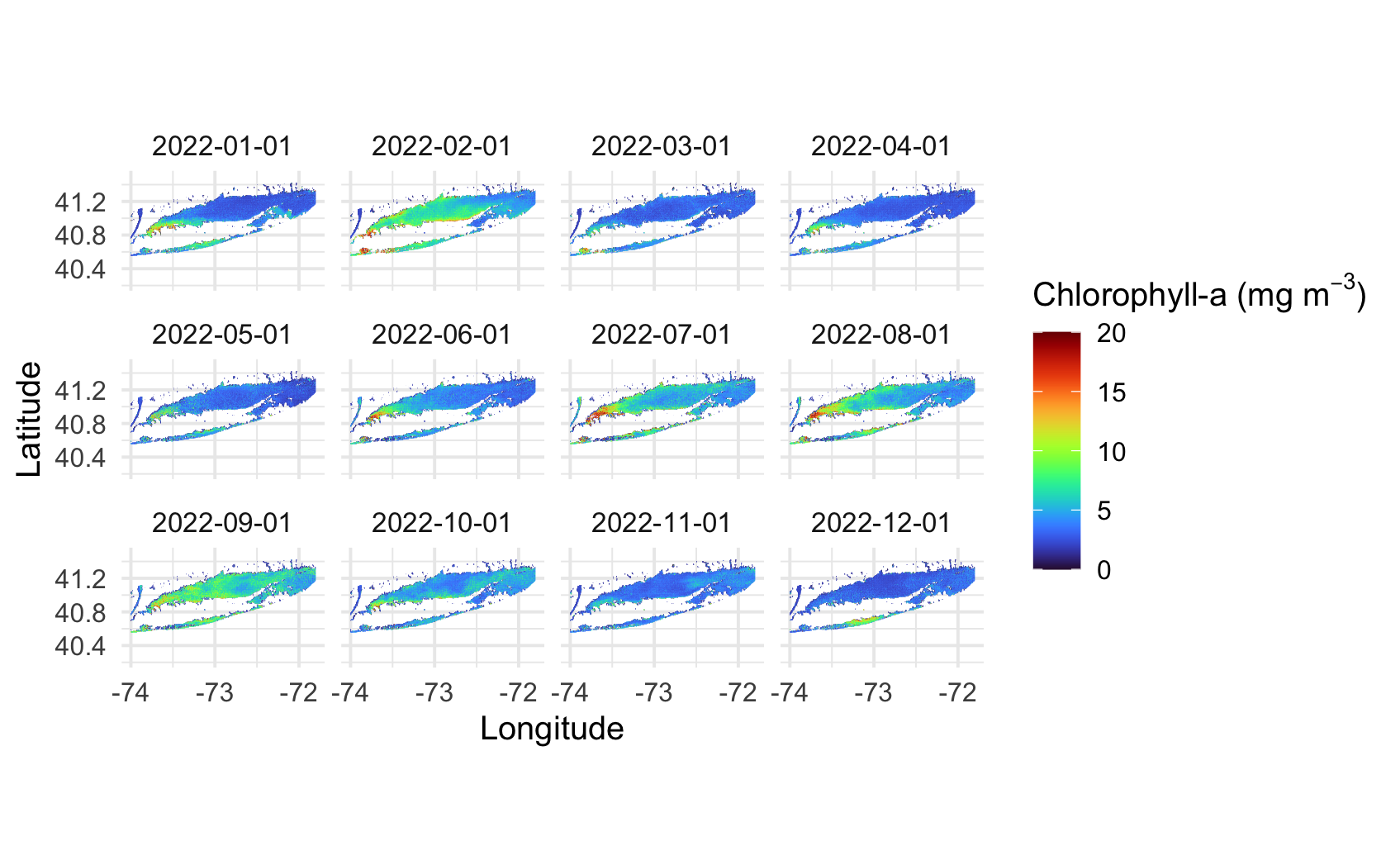
Compute the annual average for the region
Calculate the annual average chlorophyll-a at each pixel by grouping the monthly data by latitude and longitude, then taking the mean across all months. We also remove any missing values.
yearly_mean <- monthly_mean %>%
  group_by(latitude, longitude) %>%
  summarise(chlor_a = mean(chlor_a, na.rm = TRUE), .groups = "drop")
Plot the map of the 2022 average chlorophyll-a in the region
ggplot(yearly_mean, aes(x = longitude, y = latitude, fill = chlor_a)) +
  geom_tile() +
  scale_fill_viridis(
    name = bquote("Chlorophyll-a (mg "*m^{-3}*")"),
    option = "turbo",
    limits = c(0, 20),
    na.value = "transparent"
  ) +
  coord_equal() +
  labs(
    title = "Mean Chlorophyll-a\nJan 2022 – Dec 2022",
    x = "Longitude", y = "Latitude"
  ) +
  theme_minimal(base_size = 14)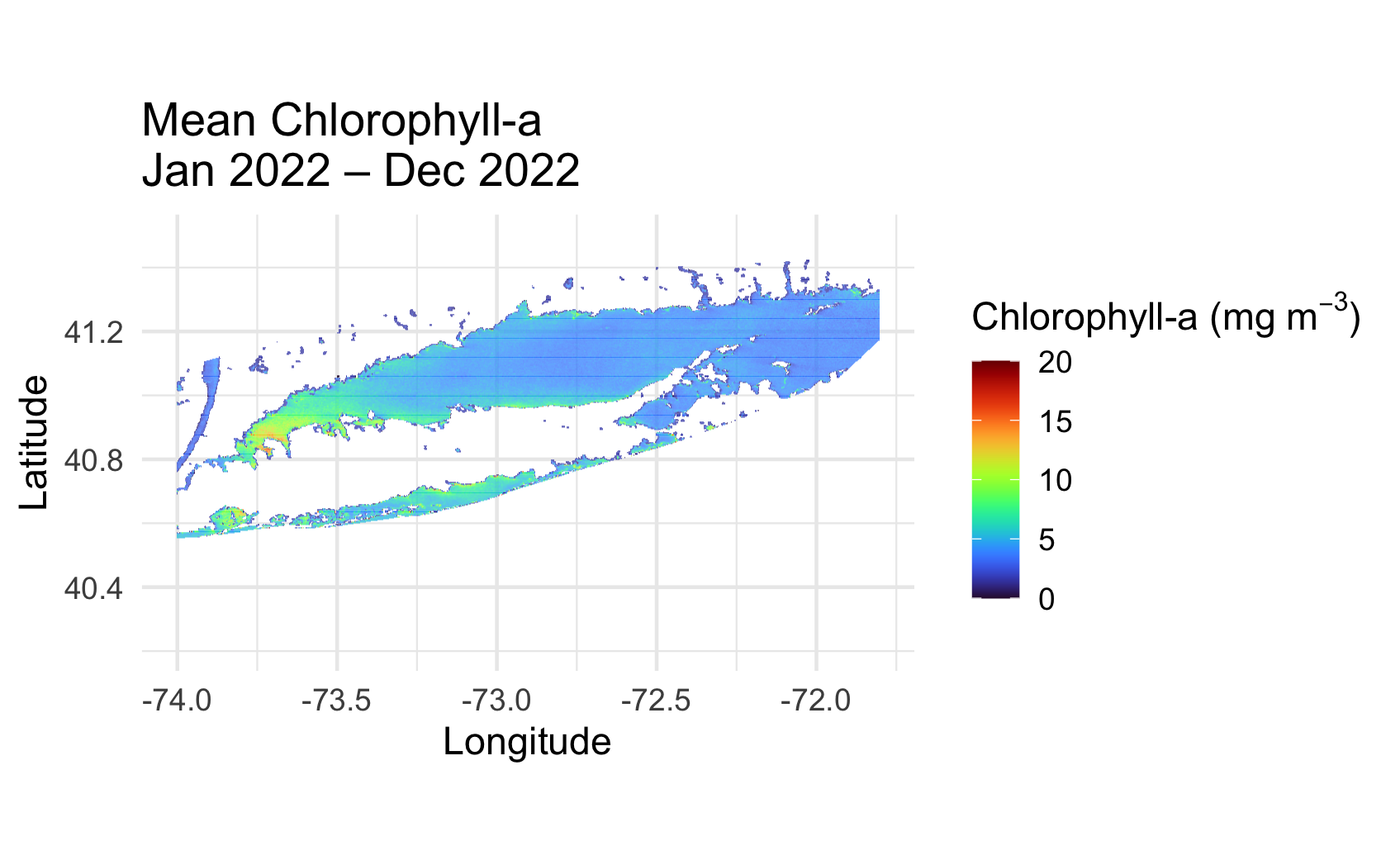
Spatial Subset and Time Series Comparing Chlorophyll-a Seasonal Cycles in Western and Eastern Long Island Sound
Subset the data
- West Long Island Sound between -73.9° to -73.1° W longitude
- East Long Island Sound between -72.9° to -71.8° W longitude
We are going to generate a time series of mean chlorophyll-a within each box.
# Subset West Long Island
west_df <- df %>%
  filter(longitude >= -73.9, longitude <= -73.1)

# Subset East Long Island
east_df <- df %>%
  filter(longitude >= -72.9, longitude <= -71.8)
Examine the structure of the subsetted data
str(west_df)

str(east_df)
Resample each subset to 8-day means
# Resample west_df
west_df <- west_df %>%
  mutate(
    period = as.Date("2022-01-01") +
      floor(as.numeric(difftime(time, as.Date("2022-01-01"), units = "days")) / 8) * 8
  )

# Resample east_df
east_df <- east_df %>%
  mutate(
    period = as.Date("2022-01-01") +
      floor(as.numeric(difftime(time, as.Date("2022-01-01"), units = "days")) / 8) * 8
  )
Compute a time series
Now, we will average all data within each subset across the latitude and longitude dimensions to produce a single time series.
west_ts <- west_df %>%
  group_by(period) %>%
  summarise(chlor_a = mean(chlor_a, na.rm = TRUE), .groups = "drop") %>%
  mutate(region = "West LIS")

east_ts <- east_df %>%
  group_by(period) %>%
  summarise(chlor_a = mean(chlor_a, na.rm = TRUE), .groups = "drop") %>%
  mutate(region = "East LIS")
Plot the time series
# Combine for plotting
ts_combined <- bind_rows(west_ts, east_ts)

# Plot the time series
ggplot(ts_combined, aes(x = period, y = chlor_a, color = region)) +
  geom_line() +
  geom_point(size = 1) +
  scale_color_manual(values = c("West LIS" = "blue", "East LIS" = "red")) +
  labs(
    title = "Seasonal Cycle of Chlorophyll-a in Long Island Sound (2022)",
    x = "Date",
    y = bquote("Chlorophyll-a (mg "*m^{-3}*")"),
    color = "Region"
  ) +
  theme_minimal(base_size = 14)