Exploring the MESI & MUNSTER eddy datasets
Load Packages
packages <- c(
  "ncdf4", "plyr", "lubridate", "rerddap", "ggplot2", "plotdap",
  "tidyverse", "scales", "rerddapXtracto", "maps", "mapdata",
  "grid", "gridExtra", "reshape2", "viridis", "plotly",
  "ggrepel", "patchwork", "magrittr"
)

to_install <- setdiff(packages, rownames(installed.packages()))

if (length(to_install) > 0) {
  install.packages(to_install)
}

purrr::walk(packages, library, character.only = TRUE)
Get the ship underway data for Nancy Foster in the Gulf in June 2025
# Download ship data
dataset <- "fsuNoaaShipWTER"

ship <- tabledap(
  dataset,
  url = "https://coastwatch.pfeg.noaa.gov/erddap/",
  fields = c("longitude", "latitude", "time", "salinity", "seaTemperature"),
  "time>=2025-06-10",
  "time<=2025-06-19"
)

# Convert longitude to 180 format for plotting and rename variables
ship <- ship %>%
  dplyr::mutate(
    longitude = longitude - 360
  ) %>%
  dplyr::rename(
    Ship_SST = seaTemperature,
    Salinity = salinity
  )
Subset track every 2 hours
Initially tried averaging into a daily product, but that produced points that were not actually along the survey track, and didn’t have enough track coverage, so instead subsetting every 2 hours.
ship_2 <- ship %>%
  dplyr::slice(seq(1, dplyr::n(), by = 120))
Get boundaries of trackline
# Define ranges and midpoint time
trange <- range(ship$time)

midt <- ship %>%
  dplyr::summarise(midt = as.character(as.Date(median(time)))) %>%
  dplyr::pull(midt)

xrange <- range(ship$longitude)
yrange <- range(ship$latitude)
Get fields of EKE, SLA and eddy labels
# The MESI data set contains SSH, EKE and the MESI data, while the MUNSTER dataset provides the
# unique identification of specific eddies.
# Here the data is being extracted for only one day, for the entire region transversed by the ship.

mesi_info <- rerddap::info(
  "noaacweddymesiplusdaily",
  url = "https://coastwatch.noaa.gov/erddap"
)

munster_info <- rerddap::info(
  "noaacweddymunsterdaily",
  url = "https://coastwatch.noaa.gov/erddap"
)

# Download gridded data
mesi_2d <- griddap(
  mesi_info,
  latitude = yrange,
  longitude = xrange,
  time = c(midt, midt),
  fields = c("mesi", "ssh", "eke")
)

eddy_2d <- griddap(
  munster_info,
  latitude = yrange,
  longitude = xrange,
  time = c(midt, midt),
  fields = c("Label_cyclo", "Label_anti")
)

# Multiple the eddy IDby -1 for cyclonic eddies to be able to distinguish them from anticyclonic eddies
eddy_2d$data <- eddy_2d$data %>%
  dplyr::mutate(
    Label_cyclo = Label_cyclo * -1
  )

# Put the data in a form for mapping with ggplot
mesi_df <- mesi_2d$data %>%
  tibble::as_tibble() %>%
  tidyr::pivot_longer(
    cols = -c(longitude, latitude, time),
    names_to = "variable",
    values_to = "value"
  )

eddy_df <- eddy_2d$data %>%
  tibble::as_tibble() %>%
  tidyr::pivot_longer(
    cols = -c(longitude, latitude, time),
    names_to = "variable",
    values_to = "value"
  )
#info() output passed to x; setting base url to: https://coastwatch.noaa.gov/erddap
#info() output passed to x; setting base url to: https://coastwatch.noaa.gov/erddapMake map of SSH
# Plot sea surface height
map_data_subset <- mesi_df %>%
  dplyr::filter(variable == "ssh")

map1 <- ggplot2::ggplot() +
  ggplot2::geom_tile(
    data = map_data_subset,
    ggplot2::aes(x = longitude, y = latitude, fill = value)
  ) +
  annotation_map(
    ggplot2::map_data("world"),
    fill = "gray70",
    color = NA
  ) +
  ggplot2::geom_point(
    data = ship_2,
    ggplot2::aes(x = longitude, y = latitude),
    color = "white",
    size = 2
  ) +
  ggplot2::scale_fill_viridis_c(
    option = "turbo",
    name = "SSH (cm)",
    limits = c(-0.4, 0.4),
    oob = scales::squish
  ) +
  ggplot2::coord_quickmap(expand = FALSE) +
  ggplot2::theme_minimal() +
  ggplot2::theme(
    panel.background = ggplot2::element_rect(fill = "black"),
    legend.position = "bottom"
  ) +
  ggplot2::labs(
    title = paste("Sea Surface Height,", midt)
  )

print(map1)

ggplot2::ggsave("SSHmap.png", plot = map1)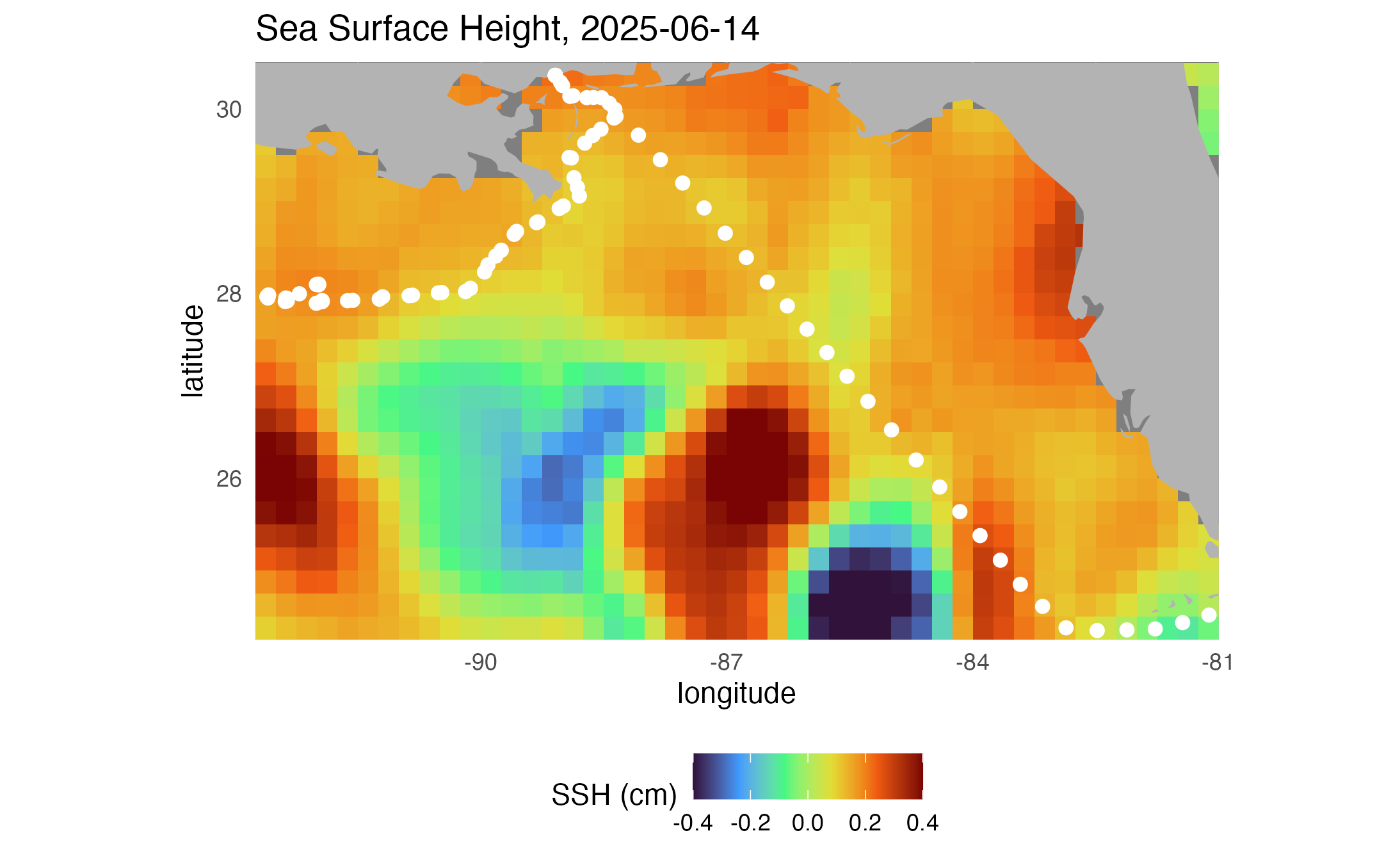
Make map of EKE
# Plot eddy kinetic energy (EKE)
map_data_subset <- mesi_df %>%
  dplyr::filter(variable == "eke")

map2 <- ggplot2::ggplot() +
  ggplot2::geom_tile(
    data = map_data_subset,
    ggplot2::aes(x = longitude, y = latitude, fill = value)
  ) +
  annotation_map(
    ggplot2::map_data("world"),
    fill = "gray70",
    color = NA
  ) +
  ggplot2::geom_point(
    data = ship_2,
    ggplot2::aes(x = longitude, y = latitude),
    color = "white",
    size = 2
  ) +
  ggplot2::scale_fill_viridis_c(
    option = "rocket",
    name = "EKE (m²/s²)",
    direction = -1,
    oob = scales::squish
  ) +
  ggplot2::coord_quickmap(expand = FALSE) +
  ggplot2::theme_minimal() +
  ggplot2::theme(
    panel.background = ggplot2::element_rect(fill = "black"),
    legend.position = "bottom"
  ) +
  ggplot2::labs(
    title = paste("EKE,", midt)
  )

print(map2)

ggplot2::ggsave("EKEmap.png", plot = map2)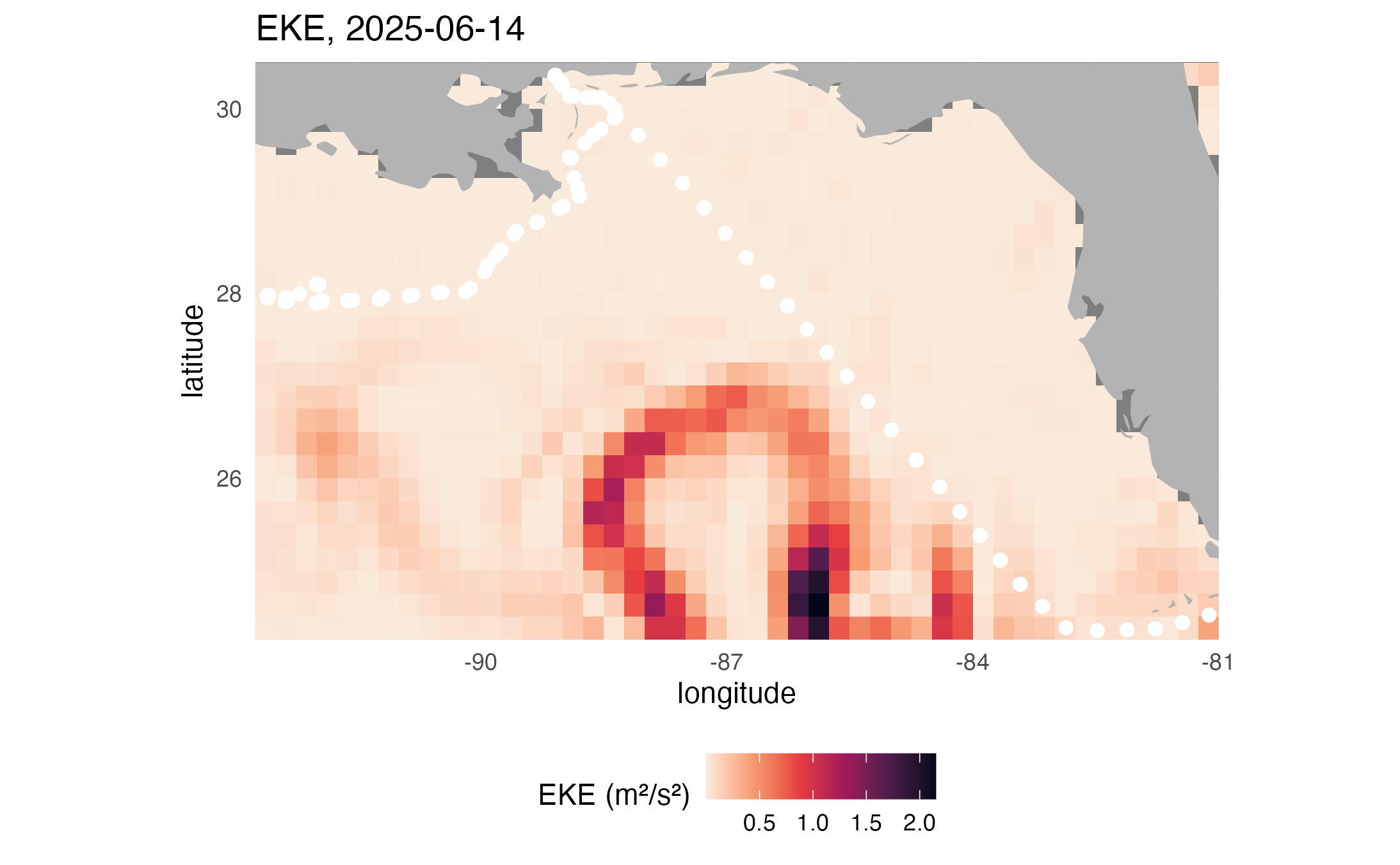
Make map of MESI
# Plot MESI
map_data_subset <- mesi_df %>%
  dplyr::filter(variable == "mesi")

map3 <- ggplot2::ggplot() +
  ggplot2::geom_tile(
    data = map_data_subset,
    ggplot2::aes(x = longitude, y = latitude, fill = value)
  ) +
  annotation_map(
    ggplot2::map_data("world"),
    fill = "gray70",
    color = NA
  ) +
  ggplot2::geom_point(
    data = ship_2,
    ggplot2::aes(x = longitude, y = latitude),
    color = "black",
    size = 2
  ) +
  ggplot2::scale_fill_distiller(
    palette = "RdBu",
    name = "MESI",
    limits = c(-0.4, 0.4),
    direction = 1,
    oob = scales::squish
  ) +
  ggplot2::coord_quickmap(expand = FALSE) +
  ggplot2::theme_minimal() +
  ggplot2::theme(
    panel.background = ggplot2::element_rect(fill = "black"),
    legend.position = "bottom"
  ) +
  ggplot2::labs(
    title = paste("MESI,", midt)
  )

print(map3)

ggplot2::ggsave("MESImap.png", plot = map3)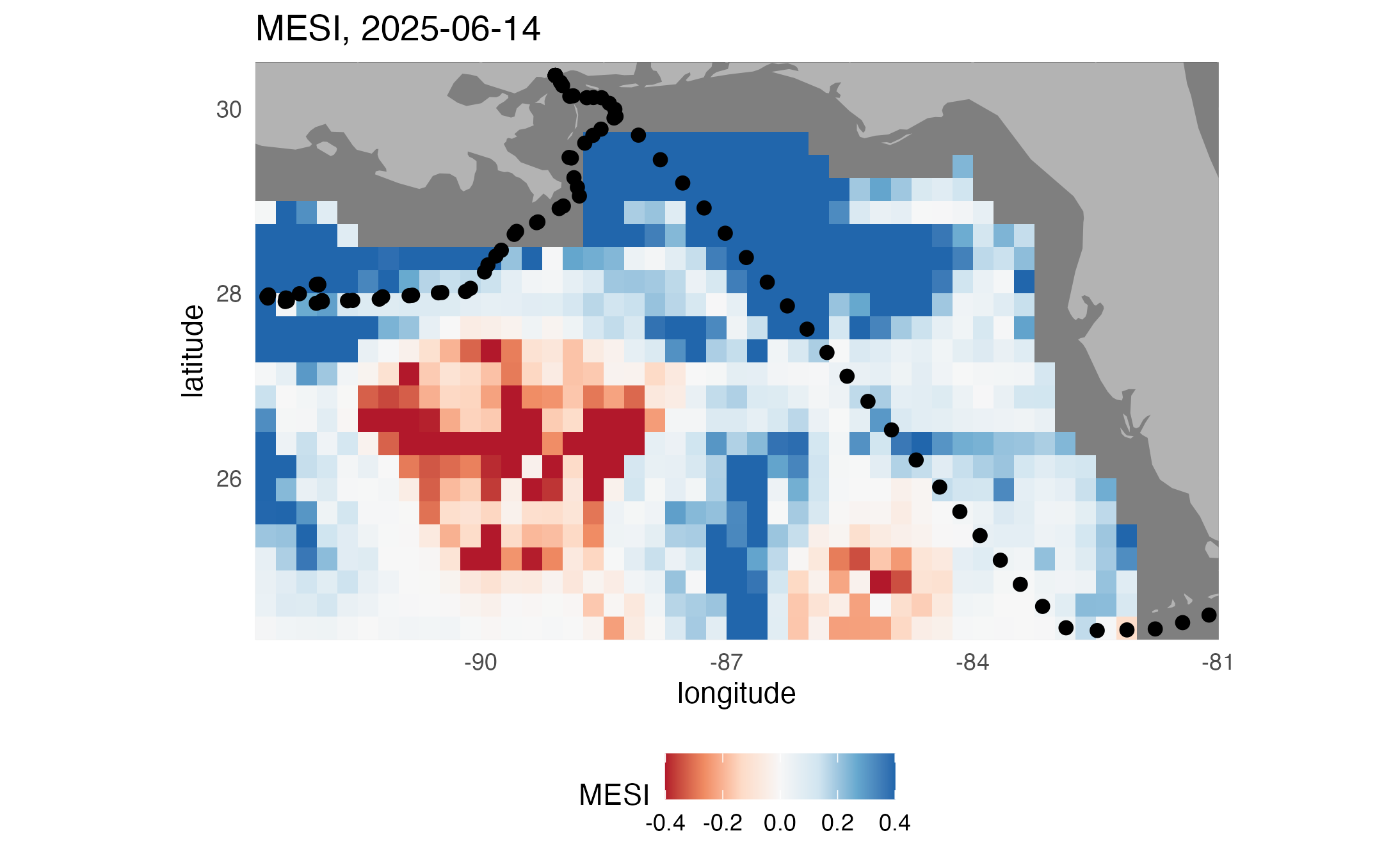
Make map of eddy location
# Identify eddy centers
eddy_centers <- eddy_df %>%
  dplyr::filter(abs(value) > 0) %>%
  dplyr::group_by(value) %>%
  # Find the center of each eddy for labeling
  dplyr::summarise(
    longitude = mean(longitude),
    latitude  = mean(latitude),
    .groups = "drop"
  )

# Plot eddy IDs
map4 <- ggplot2::ggplot() +
  ggplot2::geom_tile(
    data = eddy_df %>% dplyr::filter(abs(value) > 0),
    ggplot2::aes(x = longitude, y = latitude, fill = as.factor(value))
  ) +
  annotation_map(
    ggplot2::map_data("world"),
    fill = "gray40",
    color = NA
  ) +
  ggplot2::geom_point(
    data = ship_2,
    ggplot2::aes(x = longitude, y = latitude),
    color = "black",
    size = 2
  ) +
  ggrepel::geom_text_repel(
    data = eddy_centers,
    ggplot2::aes(x = longitude, y = latitude, label = value),
    color = "white",
    fontface = "bold",
    size = 4,
    box.padding = 0.5
  ) +
  ggplot2::scale_fill_viridis_d(
    option = "turbo",
    name = "Eddy ID"
  ) +
  ggplot2::coord_quickmap(expand = FALSE) +
  ggplot2::theme_minimal() +
  ggplot2::theme(
    panel.background = ggplot2::element_rect(fill = "gray90"),
    legend.position = "bottom"
  ) +
  ggplot2::labs(
    title = paste("Ocean Eddies,", midt)
  )

print(map4)

ggplot2::ggsave("Eddymap.png", plot = map4)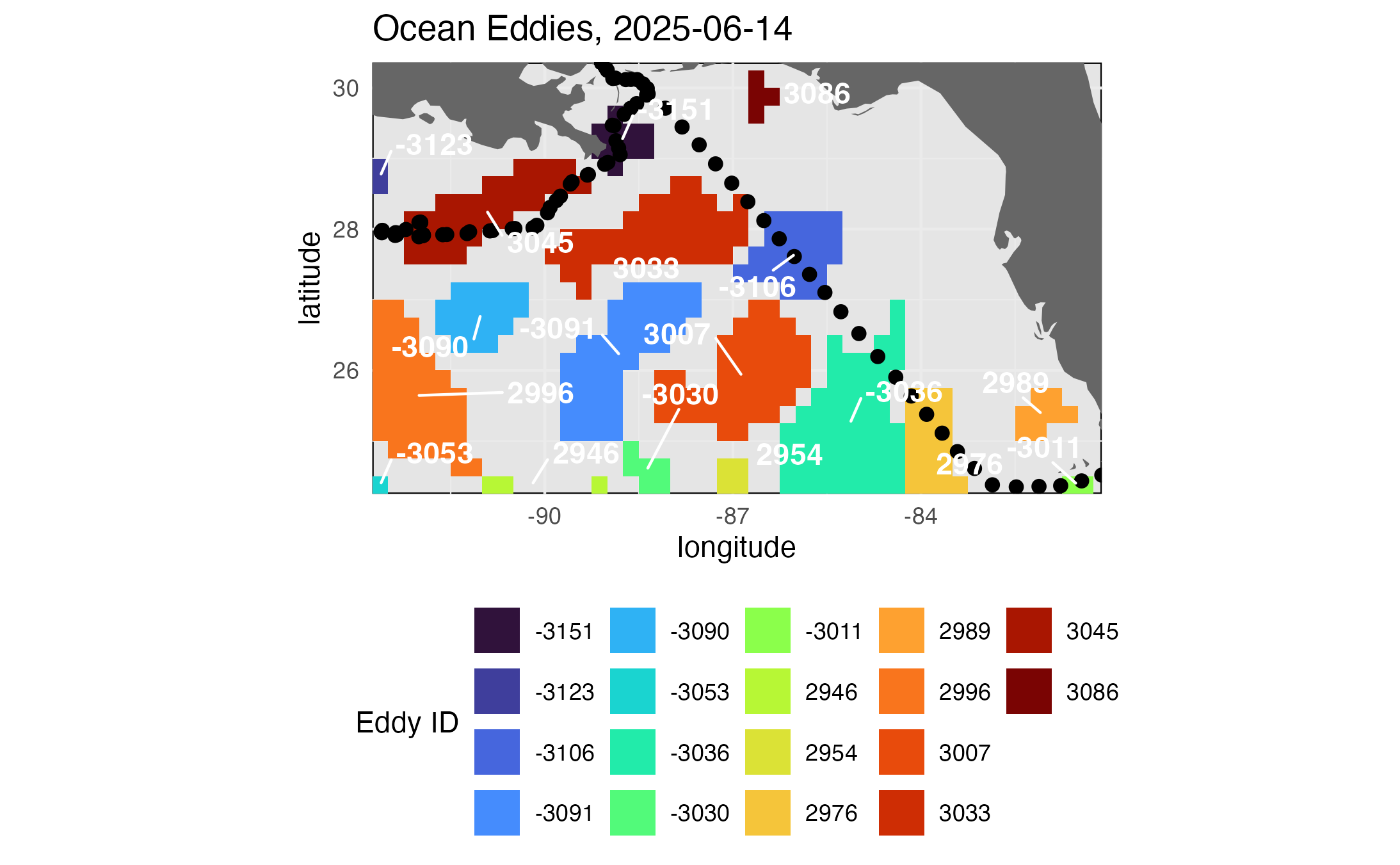
The maps above show a snapshot of conditions in the middle of the cruise track. To see a more synoptic view of of conditions along the track we will extract the match-up data for the positions along the cruise track.
Get MESI values
# Extract MESI values along the ship track
track1 <- rxtracto(
  mesi_info,
  parameter = "mesi",
  xcoord = ship_2$longitude,
  ycoord = ship_2$latitude,
  tcoord = as.Date(ship_2$time),
  xlen = 0.2,
  ylen = 0.2
)

ship_2 <- ship_2 %>%
  dplyr::mutate(
    mesi = track1$`mean mesi`
  )
Set up cruise info (for plot titles)
# Create plot title
time_summary <- ship %>%
  dplyr::summarise(
    begtime = format(min(time), "%b %d"),
    endtime = format(max(time), "%b %d, %Y")
  )

ptitle <- time_summary %>%
  dplyr::transmute(
    title = paste0("2025 Nancy Foster Tracks: ", begtime, " - ", endtime)
  ) %>%
  dplyr::pull(title)
Map tracks with MESI data
# Plot subset ship track colored by MESI
track1 <- ggplot2::ggplot(
  ship_2,
  ggplot2::aes(x = longitude, y = latitude)
) +
  annotation_map(
    ggplot2::map_data("world")
  ) +
  ggplot2::geom_point(
    ggplot2::aes(color = mesi),
    shape = 16,
    size = 2
  ) +
  ggplot2::scale_color_distiller(
    palette = "RdBu",
    name = "MESI",
    limits = c(-0.4, 0.4),
    oob = scales::squish
  ) +
  ggplot2::coord_quickmap() +
  ggplot2::labs(
    title = ptitle
  )

print(track1)

ggplot2::ggsave("mesi_track.png", plot = track1)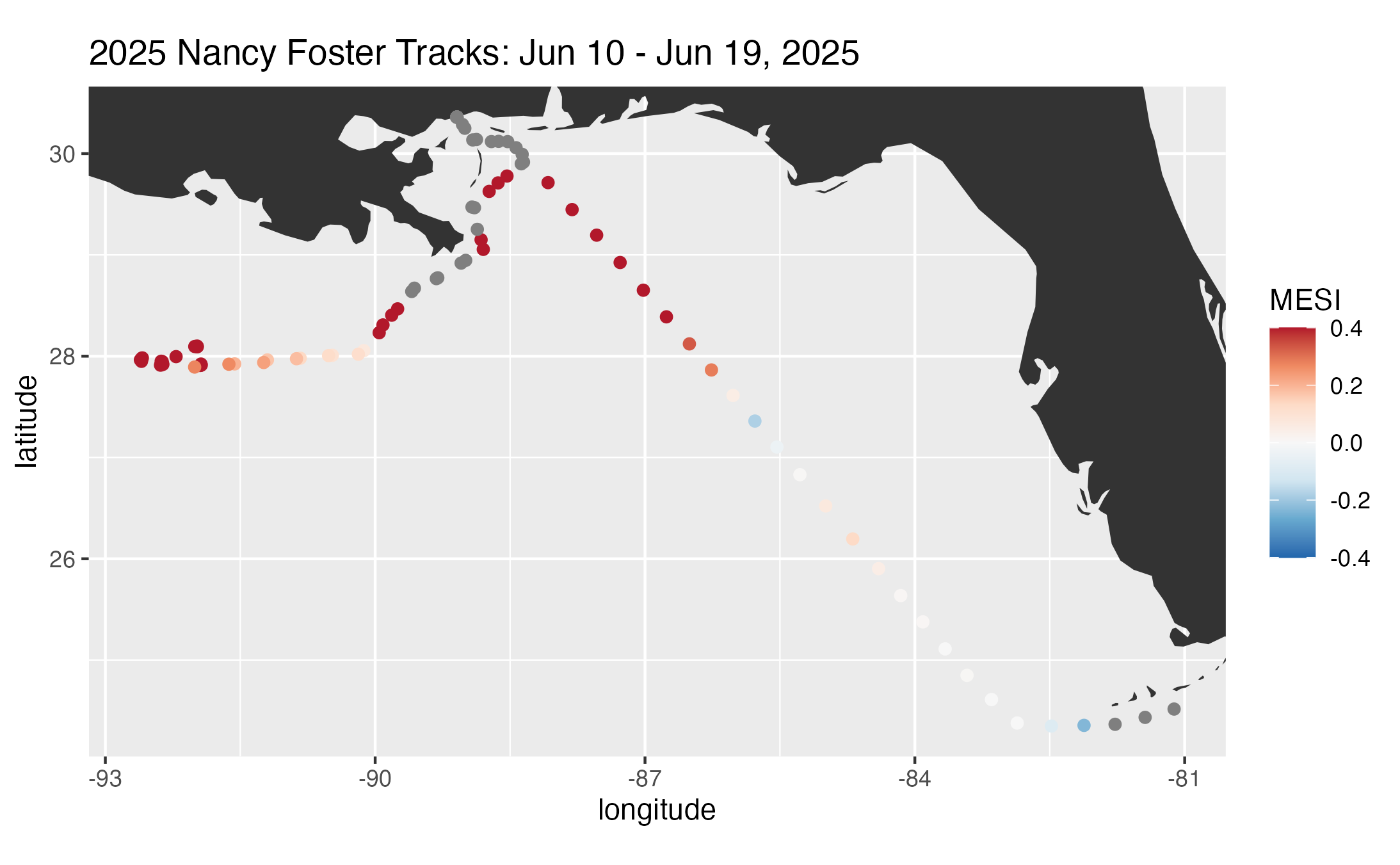
Get eddy label (anti) values
Extract anticyclonic eddy IDs along the ship track. xlen and ylen are kept very small so that a single grid value is returned. Otherwise, averaging would not preserve the actual eddy ID.
track2 <- rxtracto(
  munster_info,
  parameter = "Label_anti",
  xcoord = ship_2$longitude,
  ycoord = ship_2$latitude,
  tcoord = ship_2$time,
  xlen = 0.001,
  ylen = 0.001
)

ship_2 <- ship_2 %>%
  dplyr::mutate(
    Label_anti = track2$`mean Label_anti`
  )
Get eddy label (cyclo) values
# Extract cyclonic eddy IDs along ship track
track3 <- rxtracto(
  munster_info,
  parameter = "Label_cyclo",
  xcoord = ship_2$longitude,
  ycoord = ship_2$latitude,
  tcoord = ship_2$time,
  xlen = 0.001,
  ylen = 0.001
)

# Combine cyclonic and anticyclonic eddy IDs
ship_2 <- ship_2 %>%
  dplyr::mutate(
    Label_cyclo = -1 * track3$`mean Label_cyclo`,
    Label = Label_cyclo + Label_anti
  )
Map tracks with eddy locations
# Subset eddy observations
eddies <- ship_2 %>%
  dplyr::filter(abs(Label) > 0)

# Plot ship track with eddy labels
track2 <- ggplot2::ggplot(
  ship_2,
  ggplot2::aes(x = longitude, y = latitude)
) +
  annotation_map(
    ggplot2::map_data("world")
  ) +
  ggplot2::geom_point(
    ggplot2::aes(color = Label),
    shape = 16,
    size = 2
  ) +
  ggplot2::scale_color_gradient2(
    low = "blue",
    mid = "gray80",   # zero values shown in gray
    high = "red",
    midpoint = 0,
    oob = scales::squish
  ) +
  ggrepel::geom_text_repel(
    data = eddies,
    ggplot2::aes(x = longitude, y = latitude, label = Label),
    color = "black",
    fontface = "bold",
    size = 4,
    box.padding = 0.5
  ) +
  ggplot2::coord_quickmap() +
  ggplot2::labs(
    title = ptitle,
    color = "Eddy"
  ) +
  ggplot2::theme(
    legend.position = "none"
  )

print(track2)

ggplot2::ggsave("eddy_track.png", plot = track2)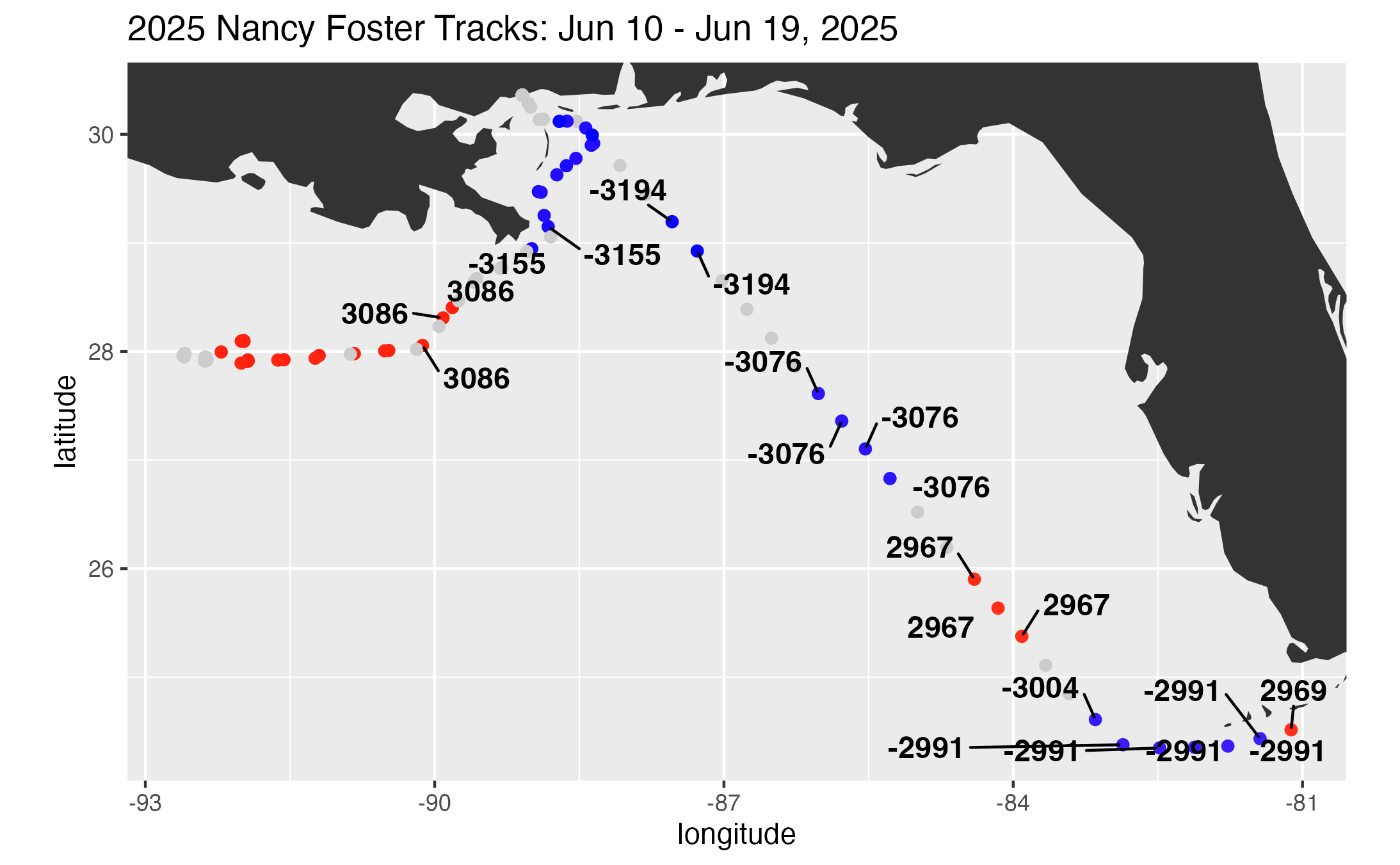
Get EKE values
# Extract EKE values along the ship track
track4 <- rxtracto(
  mesi_info,
  parameter = "eke",
  xcoord = ship_2$longitude,
  ycoord = ship_2$latitude,
  tcoord = ship_2$time
)

ship_2 <- ship_2 %>%
  dplyr::mutate(
    eke = track4$`mean eke`
  )
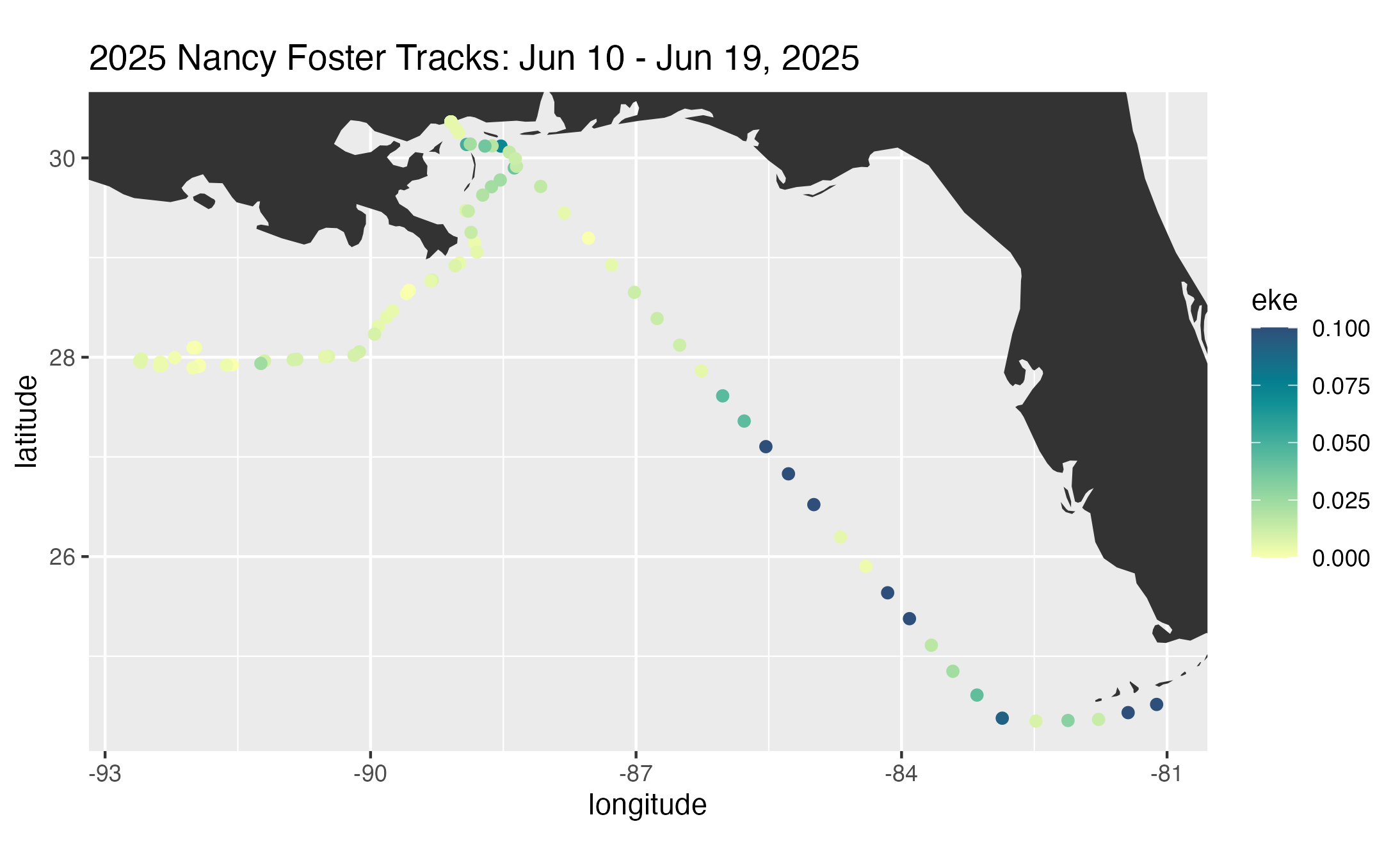
Map tracks with EKE data
# Plot subset ship track colored by EKE
pal <- rev(hcl.colors(10, palette = "BluYl"))

g <- ggplot2::ggplot(
  ship_2,
  ggplot2::aes(x = longitude, y = latitude)
) +
  annotation_map(
    ggplot2::map_data("world")
  ) +
  ggplot2::geom_point(
    ggplot2::aes(color = eke),
    shape = 16,
    size = 2
  ) +
  ggplot2::scale_color_gradientn(
    colors = pal,
    limits = c(0, 0.1),
    oob = scales::squish
  ) +
  ggplot2::coord_quickmap() +
  ggplot2::labs(
    title = ptitle
  )

print(g)

ggplot2::ggsave("eke_map.png")